


AI is writing your competitors' content. How to make sure yours still sounds like you
The more you rely on AI for your content, the more your voice quietly disappears, replaced by something clean, correct, and completely forgettable.

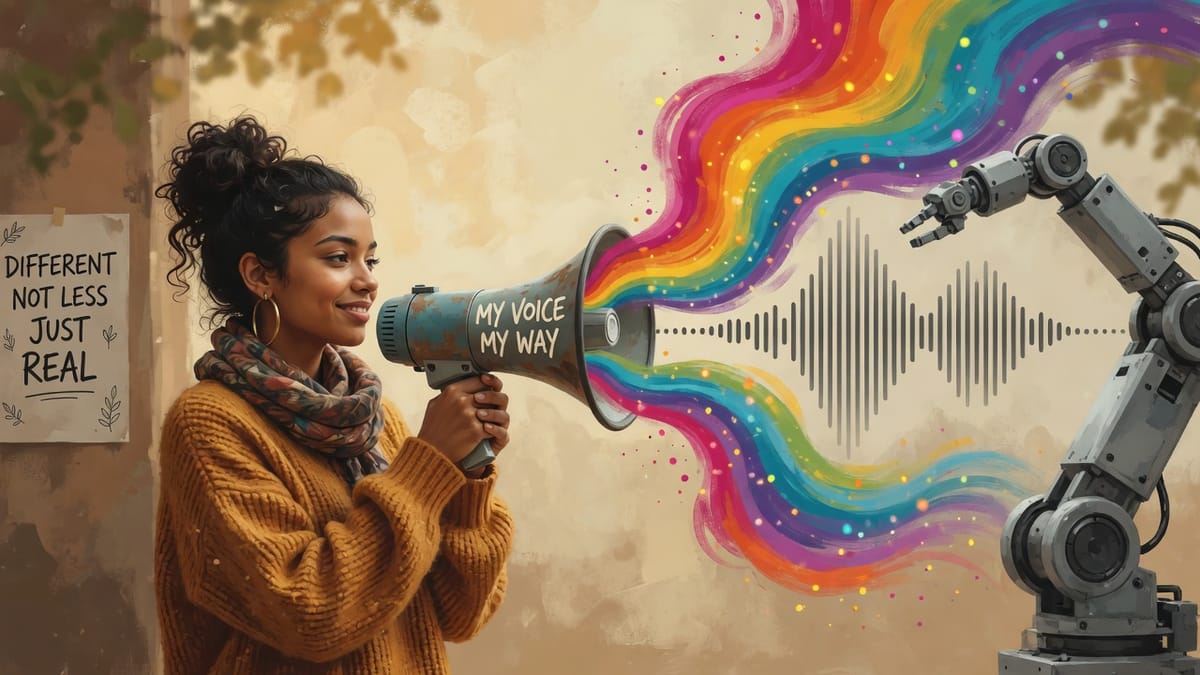
Every creator is using AI now. The ones winning are the ones who figured out where to let AI in and where to keep it out. Here is the line.
The problem nobody wants to admit
Something progressively happened over the last twelve months. AI tools became so accessible, so fast, and so good at producing content that millions of creators started using them and millions of feeds started looking, reading, and sounding exactly the same.
The captions got cleaner. The structures got more predictable. The opinions got safer. The personality disappeared.
Content begins to lose its character slowly. Everything becomes a little too neat, the sentences sound alike, and the tone feels robotic, even when what is being said is useful.
You have probably felt it yourself. You generate a caption, read it back, and something is missing. It is correct. It is coherent. But it does not sound like you. And deep down you know your audience will feel that too, even if they cannot explain why.
This is the central tension every creator is experiencing today. AI makes you faster. But speed without voice is just noise. And there is more noise on every platform right now than at any point in the history of the internet.
The creators who are building loyal, growing audiences right now are not the ones using AI the most. They are the ones who figured out exactly how to use it, and exactly where not to.
Advertisement


Why audiences can tell even when they cannot explain it
Your audience may not be able to articulate why a piece of content feels off. But they feel it immediately, and they respond to it the same way every time: they scroll past.
Today, feeds are increasingly saturated with AI-generated content. Audiences are getting better at detecting it and they react with lower engagement, less trust, and faster scroll times. Authentic, human-first content is not just a values statement. It is a competitive advantage.
What they are detecting is not the AI tool itself. It is the absence of the things that make content worth stopping for, a specific opinion, a personal story, an unexpected angle, a voice that clearly belongs to a real person with real experiences and real stakes in what they are saying.
Making AI content sound human comes down to two things: removing what makes AI sound like AI, the predictable vocabulary, the safe structures, the hedging, the absence of genuine perspective, and adding what makes human content sound human, lived experience, real opinions, specific observations, admitted failures, and personality. The second part cannot be automated. It has to come from you.
That is the line. Everything on the AI side of it: structure, speed, formatting, repurposing, first drafts. Everything on the human side of it: your perspective, your stories, your opinions, your voice. The moment you let AI cross that line, your content stops being yours.
What AI is genuinely good at and what it is not
Being honest about this distinction is the most practical thing you can do for your content strategy right now.
Where AI delivers real value:
First drafts. AI is excellent at giving you a starting point, a structure to react to, a draft to tear apart and rebuild in your own voice. Use AI for first drafts, not final ones. Generate a starting point, then edit it until it sounds like you. If it still does not sound like you, keep editing or start over with the AI output as a reference only. The draft is scaffolding, not the building.
Repurposing.This is where AI delivers its most unambiguous value. Content you have already created that already sounds like you, turning that into different formats is pure efficiency gain. A newsletter section becomes a LinkedIn post. A YouTube script becomes a TikTok caption. Your voice is already in the original, AI is just reshaping it.
Research and structure. AI can find relevant data points, organize your thinking, and suggest structures faster than you could do it manually. Use it as a research assistant and an editor, not as the writer.
Consistency. Publishing consistently is one of the hardest disciplines in the creator economy. AI helps you maintain a schedule even during your busiest weeks, not by replacing your ideas, but by reducing the friction between having an idea and getting it published.
Advertisement
 Reid HoffmanCofounder of LinkedIn, Partner at Greylock
Where AI consistently falls short:
Genuine opinions. AI produces consensus. It is trained on what has already been said, which means it gravitates toward the average take, the safe middle ground that offends nobody and surprises nobody. Your audience does not follow you for the average take. They follow you because your perspective is specific and occasionally unexpected. AI cannot produce that.
Personal stories. The specific moment, the exact conversation, the particular failure, these are yours. They are what make your content impossible to replicate. AI has no access to your lived experience, and no amount of prompting can manufacture authenticity.
Cultural instinct. Knowing what to say, when to say it, and how your specific audience will receive it is a skill built over years of showing up and paying attention. AI can approximate this but approximation is not the same as genuine understanding.
The voice document: the most underrated tool in your content strategy
Here is something practical that most creators overlook entirely.
Keep a voice document. Write down the phrases you use naturally, the topics you care about, the opinions you hold, and the way you typically open and close a piece of content.
This document serves two purposes. First, it gives you a reference to check AI-generated content against, if a draft does not match the document, it is not ready to publish. Second, it becomes the input you feed into AI tools when you want them to write closer to your voice. The more specific your voice document, the better your AI outputs will be, because you are giving the tool something real to work with rather than letting it default to generic.
Your voice document should include: words and phrases you use often, words and phrases you never use, your typical sentence length and rhythm, topics you have strong opinions on, the tone you use for different platforms, and examples of your best content that genuinely sounds like you. Build it once. Update it as your voice evolves. It is one of the most valuable assets your content business has.
A practical system for keeping your voice intact
Here is a simple workflow that lets you use AI at full speed without losing what makes your content yours:
Step one | Start with your idea, not AI's. Never open an AI tool before you know what you want to say. The idea, the angle, the opinion, that comes from you first. Even a rough sentence is enough: "I think creators are making a mistake by letting AI write their hooks." That is the seed. Now use AI to help you develop it.
Step two | Use AI for the draft, own the rewrite. Ask AI to draft a structure or a first version based on your seed idea. Then rewrite it, not lightly edit it, actually rewrite the parts that do not sound like you. Pay particular attention to the opening, the closing, and any sentence that expresses an opinion. Those are the moments that define your voice and they need to be yours.
Step three | Add one thing AI cannot generate. Before publishing anything, add at least one element that is specifically and irreducibly yours: a personal story, a specific opinion stated clearly, a reference to something from your own experience. This is what separates content that feels human from content that feels generated. One genuine moment changes the entire texture of a piece.
Step four | Read it out loud. There is a significant difference between writing that sounds written and writing that sounds spoken. "We are going to discuss the benefits of this approach" sounds written. "Let me show you why this works" sounds spoken. One is a presentation. The other is a conversation. If you cannot read your content out loud naturally, your audience will feel that when they read it silently.
Step five | Check it against your voice document. Before publishing, ask yourself: does this sound like something I would actually say? If the answer is no, even slightly, go back and fix the parts that feel off. It takes five extra minutes. It is worth it every time.
The competitive advantage hiding in plain sight
Here is the counterintuitive reality of the current content landscape.
Because so many creators are now using AI to produce content faster, the average quality of content has gone up, but the average distinctiveness has gone down. Everything is more polished. Nothing is more memorable. Audiences are scrolling faster than ever precisely because most of what they see feels interchangeable.
The creators producing the best content in 2026 are not the ones with the most sophisticated AI prompts. They are the ones who have built systems that reliably combine AI's structural efficiency with their own lived experience and perspective.
That combination, AI speed plus genuine human voice, is genuinely rare right now. And rare things get noticed.
The creators who protect their voice while using AI to work faster are not just preserving something important. They are building a competitive advantage that gets more valuable as everyone else races toward homogeneous, AI-generated sameness.
Your voice is not a nice-to-have. In 2026, it is your most defensible asset.
Start today, here is exactly what to do
Do not wait until your next piece of content to think about this. Start now:
- Open a new document and write your voice document, phrases you use, phrases you avoid, your opinions, your tone. Even a rough first version is infinitely better than nothing.
- Take your last three pieces of AI-assisted content and read them out loud. Identify the sentences that do not sound like you. Rewrite them.
- For your next piece of content, write the opening and closing yourself, before you touch any AI tool. Let AI help with everything in between. Then rewrite whatever does not sound like you.
- Add one personal story or specific opinion to every piece of content you publish from this point forward. One. That is all it takes to shift the entire feeling of a piece from generated to genuine.
Your competitors are moving fast with AI. Move just as fast but sound like yourself while you do it. That is the edge.