

Claude Fable 5 banned for foreign users - What it means for creators and entrepreneurs worldwide
Here is exactly what happened, why the US government did it, what Anthropic said in response, and most importantly, what it means for your work right now.

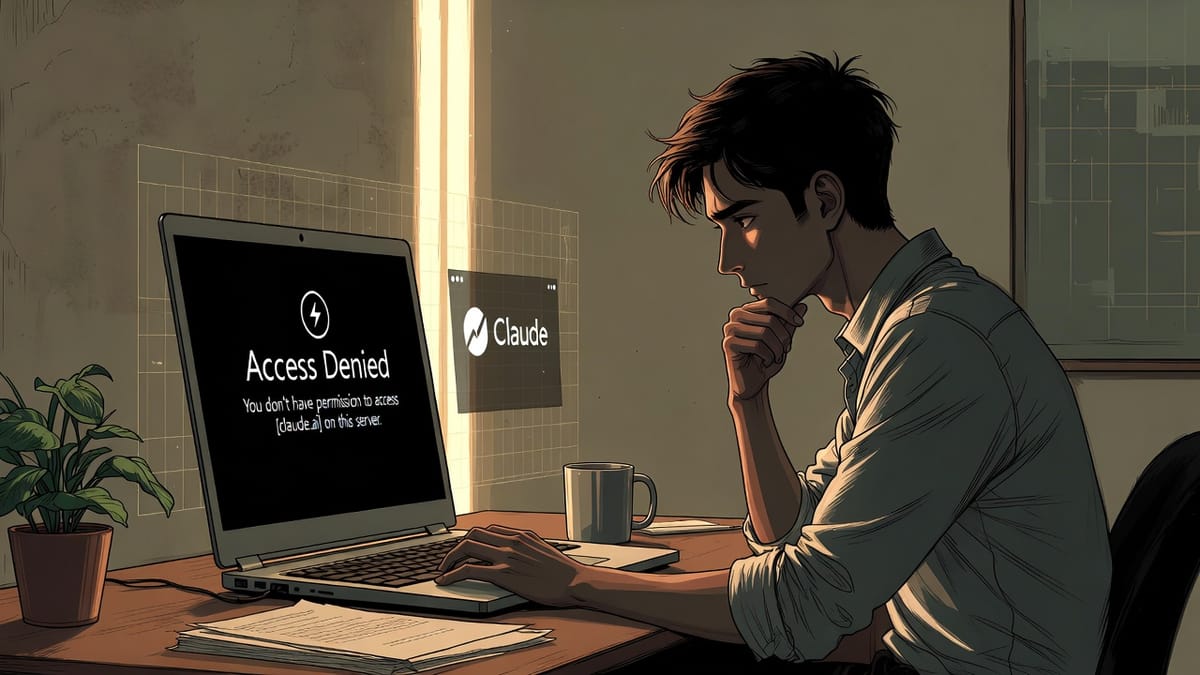
Anthropic launched its most powerful AI model ever on June 9, 2026. Three days later, the US government ordered it shut down for the entire world.
If you are a creator or entrepreneur outside the United States, or even a foreign national living inside it, you lost access to Claude Fable 5 and Claude Mythos 5 on Friday, June 13, 2026. With no warning, no specific explanation, and no timeline for when access might return.
Here is exactly what happened, why the US government did it, what Anthropic said in response, and most importantly, what it means for your work right now.
What is Claude Fable 5 and why does it matter
To understand why this ban is significant, it helps to understand what was taken away.
Claude Fable 5 is described by Anthropic as the first publicly available version of its Mythos model, a new tier of capability above the company's previous Opus-class models. Anthropic says Fable 5 excels at software engineering, knowledge work, and vision, and comes with hard safety limits that block responses in high-risk areas like cybersecurity, biology, chemistry, and distillation.
Advertisement


Fable 5's capabilities, according to Anthropic, exceed those of any model the company has ever made generally available. It is described as state-of-the-art on nearly all tested benchmarks of AI capability, showing exceptional performance in software engineering, knowledge work, vision, scientific research, and many other areas, with the longer and more complex the task, the larger Fable 5's lead over previous models.
For creators and entrepreneurs, this was not just another incremental update. It was a genuinely new class of AI capability, the kind that can handle multi-day, complex tasks that previous models simply could not sustain. Think of it as the difference between a capable assistant and a highly skilled specialist who can work independently for days at a time.
It launched on Tuesday. By Friday evening, it was gone.
What happened on June 13
Late on Friday, June 13, Anthropic announced it had received an order instructing it to suspend all access to Fable 5 and Mythos 5 by any foreign national, whether inside or outside the United States, including foreign national Anthropic employees. The company said it received the directive at 5:21 pm Eastern Time, and that the letter did not provide specific details of the government's national security concern.
The directive came from the US Commerce Department, which used national security export controls to bar Anthropic from distributing the models to any foreign national. Given the scope of the directive, Anthropic argued it had no choice but to disable the models for all users to ensure compliance.
Anthropic stated: "The net effect of this order is that we must abruptly disable Fable 5 and Mythos 5 for all our customers to ensure compliance. Access to all other Anthropic models will not be affected."
That last sentence is important. Claude Opus 4.8, Claude Sonnet 4.6, and Claude Haiku 4.5 remain fully available. This ban is specifically and exclusively targeted at the two most powerful Mythos-class models.
Why did the US government do this
Anthropic said officials told the company that the government made the decision after learning of a technique to bypass Fable 5's safeguards, safeguards designed to prevent users from accessing the powerful cybersecurity abilities of Mythos, the underlying AI model on which Fable 5 is built.
The AI behind Anthropic's Mythos model is particularly adept at detecting software vulnerabilities, some of which have remained undiscovered for decades, a capability that has been used by US authorities and selected companies to plug security gaps. However, a concern from the outset has been that such AI could become a dangerous cyberweapon in the wrong hands.
Advertisement

The Trump Administration cited national security concerns when it issued the export-control directive. The Pentagon's Chief Information Officer, Kirsten Davies, said in a post on X that the Defense Department was "prioritizing national security and the security of our warfighters," adding: "Some things are simply more important than revenue cycles, clickbait, and pre-IPO valuation. America First. Always."
Anthropic disagreed with the government's assessment. The company said it believed the jailbreak the government was citing was a narrow one that would unlock Mythos's cybersecurity capabilities in only one specific instance, not a universal one that would defeat all of Fable 5's safeguards. It also said it believed the same jailbreak could be used to elicit similar capabilities from other publicly available models.
In plain terms: Anthropic believes the government overreacted to a limited, specific vulnerability, and that disabling the entire model globally was a disproportionate response.
The bigger political picture
This ban does not exist in isolation. It is the latest chapter in an increasingly tense relationship between Anthropic and the US government.
The announcement marks Anthropic's latest run-in with the US government after a high-profile clash with the Department of Defense spilled into public view earlier this year. After negotiations between the two organizations collapsed, the DOD declared Anthropic a supply chain risk, a label historically reserved for foreign adversaries.
Anthropic is currently suing the US government over that designation. The company has consistently positioned itself as a safety-focused AI developer committed to working with governments responsibly, making the supply chain risk label and the Fable 5 ban particularly striking contradictions.
In its statement, Anthropic said: "As we have stated publicly, we believe the government should have the ability to block unsafe deployments, as part of a statutory process that is transparent, fair, clear, and grounded in technical facts. This action does not adhere to those principles."
The company added that it believes the situation is a misunderstanding and is working to restore access as quickly as possible. As of the time of writing, no timeline has been provided.
What this means for creators and entrepreneurs outside the US
This is where the story moves from geopolitics to your daily workflow and the impact is real.
If you use Claude for content creation: The models affected by this ban, Fable 5 and Mythos 5, were specifically designed for complex, long-running tasks. If you were using or planning to use Fable 5 for extended content projects, multi-step research, or automated workflows, that capability is currently unavailable to you. Claude Opus 4.8 remains available and remains a powerful tool — but it represents the previous generation of capability rather than the new Mythos-class tier.
If you build tools or products on Claude's API: Developers and entrepreneurs who had begun building products or workflows on the Fable 5 API need to temporarily revert to Opus 4.8 or Sonnet 4.6. Anthropic has confirmed that all other models remain fully operational through the API. The disruption is significant but not business-ending for most use cases.
If you are based in the US but are not a US citizen: This is the most overlooked dimension of the ban. The directive explicitly covers foreign nationals living inside the United States, including Anthropic's own employees. If you are a non-US citizen working or living in the US, you are affected by this ban in exactly the same way as someone located outside the country entirely.
If you are a US citizen: Technically, the ban does not apply to you, but because Anthropic disabled the models globally to ensure compliance, US citizens also currently have no access to Fable 5 or Mythos 5. The company has stated it is working to restore access for eligible users as quickly as possible.
The broader implication for international creators
Beyond the immediate disruption, this ban raises a question that every international creator and entrepreneur using US-based AI tools should be thinking about seriously.
What happens to your business when the most powerful tools in your workflow can be switched off overnight by a government decision you had no part in and no warning of?
This is not a hypothetical risk anymore. It happened this week. And it happened to a tool that creators and entrepreneurs around the world had begun integrating into their daily work, in some cases, building significant parts of their businesses around.
The lesson here is not to stop using AI tools. It is to build diversified AI workflows rather than deep dependency on a single model or a single provider. Anthropic's Opus models remain available. Google's Gemini, OpenAI's GPT models, and Meta's Llama models are unaffected by this directive. A workflow that relies on multiple AI providers is significantly more resilient to exactly this kind of sudden, politically driven disruption.
What to do right now
If you are an international creator or entrepreneur affected by this ban, here are the practical steps to take today:
Switch to Claude Opus 4.8 for existing workflows. It remains fully available, it is a powerful model, and for the majority of creator and content tasks it will handle everything you need. The gap between Opus 4.8 and Fable 5 is most significant for very long, complex, multi-day tasks, not standard content creation or research.
Do not rebuild your entire workflow around a replacement model just yet. Anthropic has indicated it believes this is a misunderstanding and is actively working to restore access. Making major workflow changes before the situation resolves could mean making unnecessary changes twice.
Follow Anthropic's official channels for updates. Anthropic has committed to communicating any changes ahead of time. Their blog at anthropic.com/news is the most reliable source for updates on when and how access may be restored.
Review your AI tool dependencies. Use this moment to audit which parts of your workflow rely on a single AI provider and consider building in alternatives. This is good practice regardless of how quickly the Fable 5 situation resolves.
The signal in all the noise
Claude Fable 5 was the most significant AI model launch of 2026 and it lasted three days before being shut down for the majority of the world's users. That fact alone tells you something important about the environment in which AI tools are now being built and deployed.
The technology is advancing faster than the regulatory frameworks designed to govern it. The political pressures shaping AI access are real, unpredictable, and capable of affecting your workflow with no warning. And the creators and entrepreneurs who will navigate this environment most successfully are the ones who stay informed, build resilient systems, and treat these disruptions as signals rather than surprises.
The Fable 5 ban is not the last story of this kind. It is the first of many.
Disclosure: This blog may contain affiliate links. If you purchase through these links, we may earn a commission at no extra cost to you. This does not influence our editorial content.
This article covers a fast-developing story. Information is based on official statements from Anthropic and reporting from major news outlets as of June 14, 2026. The situation may have changed since publication, check Anthropic's official blog for the latest updates. Always refer to official sources for the latest updates.