

How AI can help you build more without destroying yourself
Nobody in the creator economy is going to tell you this, so I will: you are allowed to build at a pace that does not destroy you.

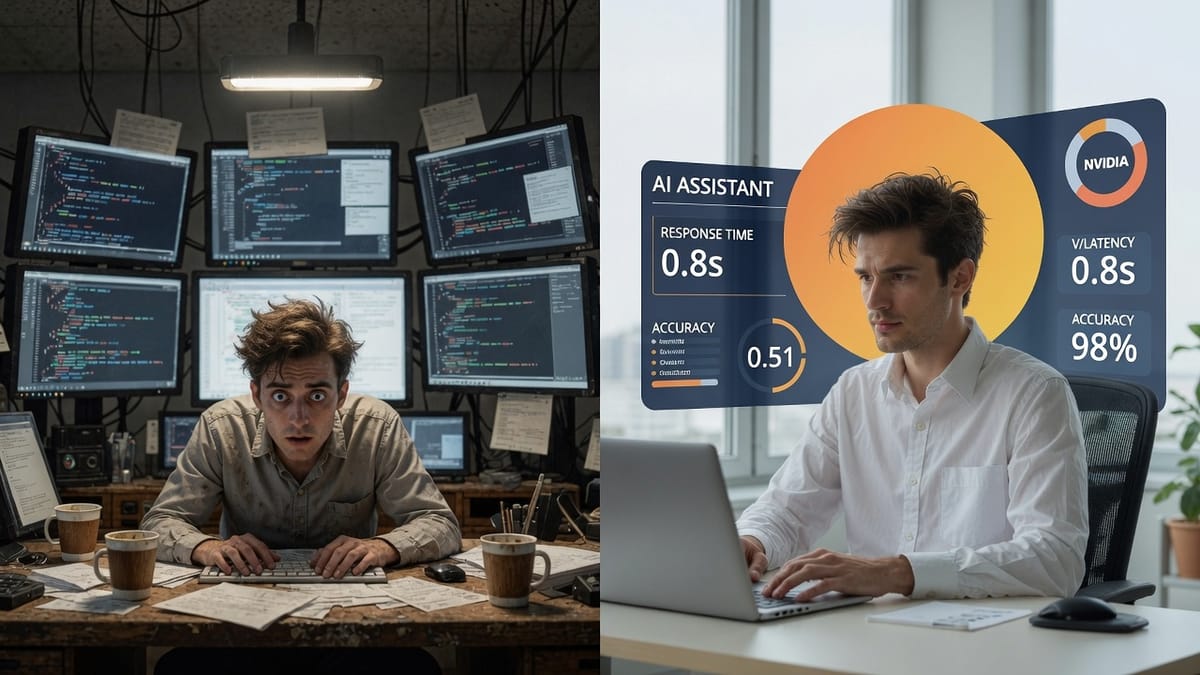
You built something real. You showed up consistently, created content people actually cared about, and carved out a space for yourself in one of the most competitive industries on the planet. That took courage, discipline, and more late nights than anyone else will ever see.
And yet, if you are honest with yourself, something feels off. The passion that made you start is harder to find. The ideas that used to flow freely now require effort. The platform that once felt exciting now feels like a treadmill you cannot get off.
If that sounds familiar, you are not alone. Not even close.
The numbers nobody in the creator economy wants to talk about
62% of creators are facing burnout in 2026, driven by relentless algorithm changes and an impossible gap between how much content platforms demand and how much any one person can sustainably produce.
A Creator Economy Research Institute study of full-time creators revealed that 47% have considered leaving content creation entirely in the past six months, and 71% say their workload has increased significantly over the past two years.
The most comprehensive study to date on creator mental health found that 58% of creators say their self-worth declines when their content underperforms, and 69% reported financial insecurity as a direct result of their work.
A Harvard T.H. Chan School of Public Health study found that digital content creators experience high rates of anxiety, depression, and burnout, with one in ten reporting suicidal thoughts related to their work, nearly double the broader population rate.
These are not the numbers of an industry thriving. They are the numbers of an industry that has been asking creators to do too much, alone, for too long, without the systems, support, or infrastructure to make it sustainable.
And the most painful part? Only 8% of creators describe their mental health as excellent. For those who have been creating for eight or more years, that number drops to 4%. More experience accelerates burnout, not immunity to it.
Why burnout hits creators differently
Burnout is not unique to the creator economy. But the specific way it manifests for creators is unlike almost any other profession, and understanding that difference is the first step toward addressing it honestly.
Most creators work more than 50 hours per week including weekends, with no health insurance, no retirement plan, no paid time off, and income that swings by 30% or more month to month. This combination of unpredictable income, no safety net, and constant work demands creates a perfect storm for burnout.
There is also a deeply personal dimension that makes creator burnout especially corrosive. Audiences demand authenticity, vulnerable, personal, emotionally raw content. Creators regularly share their struggles, traumas, and insecurities to connect with their audiences. But this emotional labor is exhausting and often uncompensated. When your life is your content, where do you draw the boundaries?
Advertisement
The root of the problem appears to be an unhealthy relationship with metrics. Creators who check analytics obsessively, reviewing every post multiple times per day, have significantly worse emotional wellbeing scores. One creator described it this way: "I check analytics before I even brush my teeth."
Perhaps most importantly, creator burnout is deeply isolating. 54% of creators say they want access to peer support networks or creator communities, yet only 27% are currently part of one, and 66% have never been part of a creator community at all. We are all trying to build something meaningful, largely alone.
This is the honest picture of what the creator economy looks like from the inside in 2026. Not the highlight reel. The real thing.
The structural problem and why hustle alone cannot fix it
Here is something important that most burnout advice gets wrong: burnout is not a personal failure. It is a structural problem.
Creator burnout grows from structural pressure, not personal weakness. Relentless algorithms and unsustainable audience expectations push creators past their limits. 77% of creators report frequent algorithm changes that force constant adaptation, and 67% cite lack of transparency about those changes as a major stressor.
The platforms are demanding more content, more frequently, at higher quality, across more channels, simultaneously. That demand curve is not going to flatten. If anything, it will steepen as AI-generated content continues to flood every feed and the bar for standing out rises further.
The creators who survive and thrive in this environment are not the ones who hustle harder. They are the ones who build smarter, who design their content businesses around systems that make sustainable output possible, rather than relying on sheer personal willpower to produce indefinitely.
And right now, the most powerful system available to solo creators is AI.
What AI actually changes for burned-out creators
This is not about replacing your creativity with a machine. It is about removing the parts of your workflow that drain your energy without adding value to your audience, so you can protect the parts that only you can do.
Creators themselves identified using AI and scheduling tools to reduce workload as one of the top three strategies for preventing burnout, alongside setting work-life boundaries and taking time off more regularly.
Here is what that looks like in practice:
AI removes the blank page problem. One of the most energy-draining parts of content creation is not the creating. It is the starting. Staring at a blank page or an empty script, trying to generate an idea from nothing, after an already exhausting week. AI eliminates that friction entirely. You bring the direction, a topic, an angle, a rough idea, and AI gives you a starting point to react to. The creative energy you save by not starting from zero is significant, compounded across every piece of content you produce.
AI handles the repetitive work that nobody enjoys. Scheduling. Formatting. Repurposing. Caption writing. Email sequences. These are the tasks that fill hours of a creator's week without requiring any of the creativity that made them want to create in the first place. Every hour spent on these tasks is an hour not spent on the work that actually moves the needle, the ideas, the storytelling, the community building that only you can do. AI handles the repetitive layer so your best energy goes to the creative layer.
AI makes consistency possible without consistency costing everything. TikTok creators burn out 40% faster than YouTube creators due to content velocity demands. The pressure to post daily, or multiple times daily, is one of the most direct drivers of burnout in the creator economy. AI makes it possible to maintain a consistent publishing schedule without that schedule consuming every waking hour. You batch your ideas and your creative input in focused sessions. AI helps you execute consistently in between. Your audience sees you showing up regularly. Your nervous system gets to rest.
AI gives you back your weekends. 81% of creators work more than 50 hours per week including weekends. That is not sustainable, not financially, not creatively, and not personally. AI-powered scheduling, content repurposing, and automated workflows mean that the work you do during the week keeps running over the weekend without you having to be present for it. Your content calendar keeps moving. Your inbox gets managed. Your posts go out. And you get to be a human being for two days.
AI protects your creative energy for the work that matters. This is the most important shift of all. Burnout does not come from doing too much of the work you love. It comes from doing too much of the work you do not love, the administrative, repetitive, mechanical parts of running a content business, until there is no energy left for the parts that actually fulfil you. AI takes the mechanical layer off your plate. What remains is the creative work, the community connection, and the strategic thinking that make content creation worth doing in the first place.
What sustainable creation actually looks like
Building a creator career that lasts requires rethinking the relationship between output and energy, not as a nice-to-have, but as a non-negotiable business strategy.
Creator burnout recovery takes six to twelve weeks with proper support. Without intervention, recovery takes six months or longer, and some creators never return to the work at all. The income impact is severe: creators in burnout see a 25 to 35% reach decline within 60 days. The stress affects performance. Performance drops create more stress. It becomes a cycle that is genuinely hard to break.
Prevention is not just better than cure. It is the only viable strategy for a long-term creator career.
Here is what the most sustainable creators in 2026 have in common:
They treat their creative energy as a finite resource and protect it accordingly. They build systems, AI-assisted workflows, content batches, and scheduled publishing, that keep their business running without requiring their constant presence. They have clear boundaries between content time and recovery time, and they hold those boundaries even when the algorithm seems to be rewarding more output. They measure success by the quality of what they produce and the depth of their audience relationships, not by daily posting frequency or real-time analytics. And they have stopped trying to do everything alone.
The message from the data is clear: you cannot do this alone. Building peer networks, creator communities, and genuine relationships with other people who understand this work is not optional. It is one of the most protective factors against burnout that exists.
The permission you did not know you needed
Here is something nobody says enough in the creator economy: you are allowed to build at a pace that does not destroy you.
You are allowed to take a weekend off without catastrophizing about the algorithm. You are allowed to publish three times a week instead of seven. You are allowed to use AI to handle the work that drains you so you can protect the work that fills you. You are allowed to build something sustainable instead of something spectacular and short-lived.
Speed leads to burnout. Strategy leads to longevity. The creators who are still here in five years will not be the ones who posted the most in 2026. They will be the ones who built systems that allowed them to keep showing up, creatively, consistently, and without running themselves into the ground to do it.
You started creating because you had something to say. Something to share. Something to build. That reason has not disappeared. It has just gotten buried under the weight of doing too much alone.
AI does not replace what makes your content worth following. It removes the weight that was burying it.
Use it. Build something that lasts. And give yourself permission to still be here, healthy, creative, and genuinely thriving, years from now.
Disclaimer: This article discusses creator mental health and burnout. If you are experiencing serious mental health challenges, please reach out to a qualified mental health professional. This article is for informational purposes only and does not constitute medical or psychological advice.
Disclosure: This blog may contain affiliate links. If you purchase through these links we may earn a small commission at no extra cost to you. This does not influence our editorial content.