

Instagram's algorithm is now your creative director
Instagram can now tell you exactly what your audience wants from you, based entirely on what they have already shown you through their behavior.

Affiliate Partner: Littlebird. The AI assistant that thinks like you.
 Brian CleggAuthor
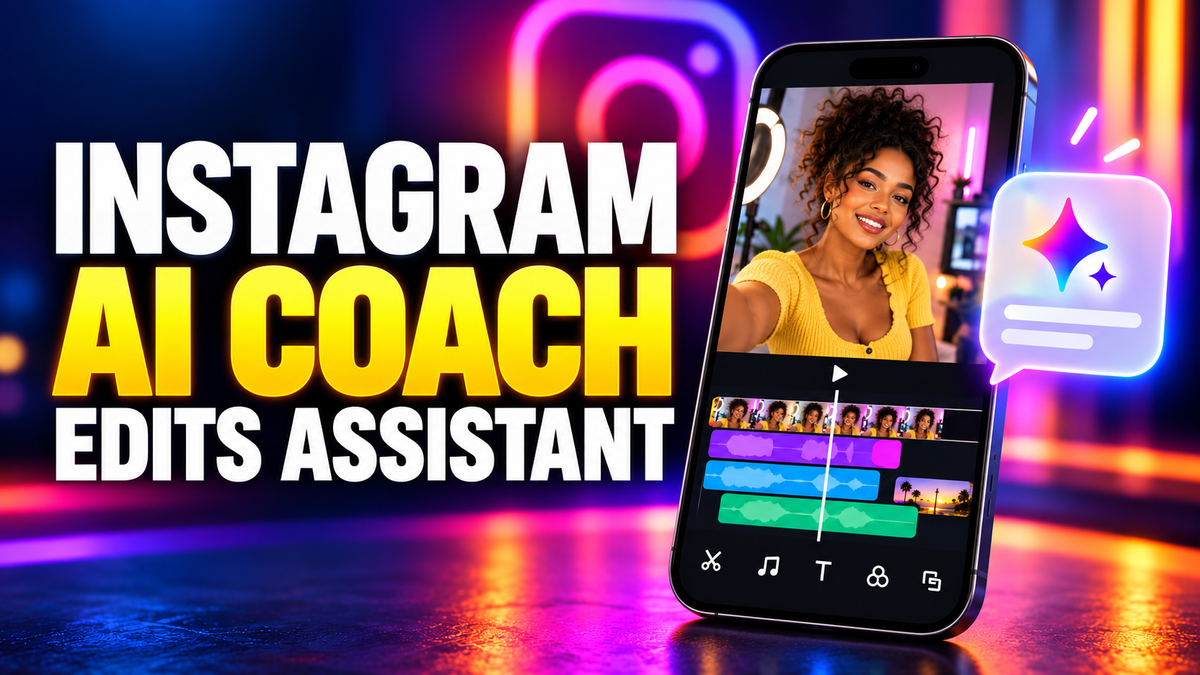
Instagram just gave every creator something that used to cost thousands of dollars a month to access: a dedicated analyst who has read every piece of content you have ever published, studied how your audience responded to all of it, and is ready to tell you exactly what to make next.
It is not a human analyst. It is an AI assistant built directly into Instagram's Edits app. And it launched on October 3, 2026.
The feature is called the Edits AI assistant. It analyzes your own content performance, your audience's interests, Instagram trends in your niche, and the comments your posts have received. Then it turns all of that analysis into specific, personalized suggestions about what content to create, what hooks to use, what captions to write, and what audio to pair with your next video.
This is not a generic content idea generator. It is a system that has studied your specific account, your specific audience, and your specific performance history. And it is available right now to every creator using the Edits app in the United States.
What the Edits AI assistant actually does, in plain language
Before getting into what this means strategically, it is worth being precise about what the feature actually does, because the description sounds more abstract than the reality.
The Edits AI assistant is a chat interface built into Instagram's Edits video editing app. You open it, ask it a question or describe what you are trying to make, and it draws on four specific data sources to give you a personalized response.
The first data source is your own content performance. It has access to the analytics from your Instagram account, which posts performed well, which underperformed, what your completion rates look like, which formats your audience responds to most strongly. This is the data you could theoretically pull yourself from Instagram Insights, but that most creators never look at systematically because it is time-consuming to organize and interpret.
The second data source is your audience's interests. Instagram's system builds a profile of what your specific audience engages with across the platform, not just on your account. This gives the AI assistant context about what your followers care about beyond the content you have already made, which is the kind of insight that used to require expensive third-party audience research tools.
The third data source is Instagram trends in your niche. The assistant monitors what is currently performing well across Instagram in topics and formats relevant to your content category. This is real-time competitive intelligence that tells you what the platform is rewarding right now in your specific space.
The fourth data source is your comments. The assistant reads the comments your posts have received and uses them as a signal of what your audience is thinking, asking, and responding to. Comments are one of the richest sources of audience intelligence available to any creator, but most creators read them without systematically analyzing what patterns they reveal. The AI does that analysis automatically.
From those four sources, the assistant can generate specific video concept ideas based on what has worked for you before, suggest hooks for your next post that are grounded in your past performance data, write caption options tailored to your voice and your audience's engagement patterns, recommend trending audio that fits your niche and your style, and identify which of your content categories is performing strongest so you can lean into it more deliberately.
Instagram's product team described the intent clearly: the assistant is designed to handle the research and analysis while creators remain responsible for deciding what they ultimately make. That division of labor is the most important design principle in the entire feature and the one that determines whether it helps or hurts your content.
The real-world example that shows why this matters
The most useful way to understand what the Edits AI assistant actually changes for creators is through the example Instagram shared when announcing the feature.
A vegan creator called turnipvegan used the assistant to analyze his own content performance. What it identified was something he had not explicitly noticed himself: his videos documenting his greenhouse project were performing significantly stronger than his cooking content. The greenhouse videos were generating more views, more completion, more saves, and more comments than the cooking videos he had been making for longer.
Without the AI assistant, turnipvegan could theoretically have identified this pattern himself by spending time in Instagram Insights comparing his posts. But the reality for most creators is that they are too close to their own content to see the patterns clearly, and the time required to do that analysis manually competes with the time required to actually make more content. Most creators do not do it consistently.
The assistant surfaced the insight in minutes. And that insight had a direct, actionable implication: make more greenhouse content. Not because it fits a trend or because a generic content strategy template says to double down on what works, but because his specific audience's specific behavior demonstrated a clear preference.
That kind of personalized, data-grounded creative direction used to be available only to creators who either had a team member dedicated to analytics or could afford to pay for professional audience research services. The Edits AI assistant makes it available to every creator with an Instagram account, regardless of their follower count or their budget.
Why Instagram built this and what it signals about the platform's direction
Understanding why Instagram introduced this feature helps you understand what the platform is trying to become for creators, and what its strategy is for Q4 2026 and beyond.
Instagram has been building toward a model where the platform itself becomes a more active partner in creator success rather than a passive distribution channel that creators have to figure out independently. The Edits app launched earlier this year as a dedicated video creation tool separate from the main Instagram app, specifically designed for creators who treat content production seriously. The 20-minute Reels extension that launched this week extends the creative canvas. And now the AI assistant adds the analytical and strategic layer.
Taken together, these moves paint a picture of what Instagram wants to be: not just the place where you publish content, but the place where you create it, analyze it, optimize it, and develop your strategy for making more of it. A creative studio and a strategic advisor in one app.
This matters for creators beyond the specific features because it tells you where Instagram is investing its product development resources. The platform is betting that creators who use Instagram's own tools more deeply and more consistently will produce better content, grow faster, and stay more committed to Instagram as their primary platform. The AI assistant is not just a feature. It is an attempt to become indispensable to the creator's workflow in a way that the core Instagram app never was.
That strategic intent is worth understanding because it tells you how Instagram will likely continue to develop its creator tools. More analysis. More personalized suggestions. More AI-powered creative direction. The Edits AI assistant is the first version of something that will become significantly more capable over the next 12 months.
The Instagram algorithm context that makes this even more significant
The Edits AI assistant does not exist in isolation. It is arriving at the same moment that Instagram's algorithm has undergone some of its most significant changes of the year, and understanding both together gives you a clearer picture of what actually drives performance on the platform right now.
Instagram officially transitioned to views as the primary metric across all formats in 2026. Reels, Stories, Photos, and Carousels are now all measured and ranked primarily by view count rather than the engagement rate metrics that previously dominated. This unification of the metric system across formats means that the same basic logic now governs how Instagram evaluates all of your content regardless of what format you publish in.
Instagram's 2026 algorithm rewards creators who build genuine communities over those accumulating passive audiences. The platform now calculates what it calls interested audience reach, prioritizing content distribution to the subset of your followers who actively engage rather than broadcasting equally to your entire follower base. A creator with 10,000 highly engaged followers now consistently outperforms a creator with 100,000 passive ones in terms of actual reach and distribution.
Instagram-filmed content receives a three to five times reach multiplier compared to content that the algorithm detects was filmed outside Instagram or imported from another platform. This is a significant organic advantage that is built directly into how the algorithm evaluates content quality.
The algorithm also now reads caption text and indexes it for in-app search and Explore matching. This means that how you write your captions affects not just whether existing followers engage with your post but whether new audiences discover it through search, which directly connects caption writing to the discovery layer of the platform.
The Edits AI assistant is designed to help creators navigate exactly these algorithmic realities. When it analyzes your performance and suggests hooks, captions, and content concepts, it is drawing on an understanding of what the current algorithm rewards, not just what worked for you historically. The two data sources together, your personal performance history and the platform's current algorithmic priorities, produce suggestions that are simultaneously personalized to your account and calibrated to what the platform is rewarding right now.
What it helps with and what it does not
The Edits AI assistant is a genuinely useful tool. But it is worth being clear about the specific things it helps with and the specific things it cannot do, because conflating the two leads to creators either over-relying on it in ways that hurt their content or under-using it in ways that leave real value on the table.
What it genuinely helps with: identifying patterns in your own performance data that you would miss or take much longer to see manually, generating specific content ideas grounded in what your audience has already demonstrated they respond to, suggesting caption and hook variations that are informed by your past performance rather than generic best practices, and keeping you current on audio and format trends in your niche without requiring you to spend time monitoring competitor content yourself.
What it cannot do: tell you what your perspective should be on any topic, generate the ideas that come from your lived experience and specific knowledge, decide which of its suggestions is worth pursuing based on your brand direction and values, or replace the creative judgment that determines whether a piece of content is genuinely good rather than just algorithmically optimized.
The creator who uses the Edits AI assistant well treats it as a research and analysis tool that informs their creative decisions rather than as a content factory that generates their creative decisions for them. The turnipvegan example is instructive precisely because of what he did with the insight the assistant provided. The assistant identified that greenhouse content was outperforming cooking content. He still had to decide what to actually make, how to film it, what angle to take, and what his specific perspective on it was. The assistant handled the data. He handled the creativity.
That division of labor is what produces content that is both algorithmically informed and genuinely human. When the line blurs, when creators ask the assistant to generate their ideas and then publish the output with minimal human input, you get content that is optimized but empty. And Instagram's own algorithm, which now specifically rewards genuine community building and interested audience engagement over passive reach accumulation, will penalize that emptiness in its distribution decisions.
What the views-first algorithm means for how you use the assistant
The shift to views as Instagram's primary metric in 2026 has a specific implication for how you should interpret the suggestions the Edits AI assistant generates.
Views measure whether people choose to watch your content. They are a proxy for whether your hook, your thumbnail, your caption, and your overall content concept are compelling enough to get someone to stop scrolling and actually engage. High view counts with low completion rates tell you that your hook is strong but your content is not delivering on its promise. High completion rates with low view counts tell you that your content is good but your hook is not compelling enough to attract viewers in the first place.
The Edits AI assistant, by analyzing your performance data across both dimensions, can help you identify which specific problem you are solving. A creator whose videos consistently get initial views but poor completion needs different advice from a creator whose videos get strong completion but struggle to attract initial views. The assistant's personalized analysis should, in theory, be able to distinguish between these two situations and generate suggestions accordingly.
When you use the assistant, pay particular attention to the hook suggestions it generates. The hook is the element that determines whether someone decides to watch your video, which is now the primary metric Instagram uses to evaluate and distribute your content. A hook that converts browsers into viewers is the most valuable creative element in any Instagram video in 2026. Getting the assistant's input on hook variations for your specific content type and your specific audience is one of the highest-leverage uses of the tool.
X's Grok has also been offering personalized content insights to creators
Instagram is not the first platform to move toward AI-powered creative assistance for creators in 2026. X's Grok has been offering personalized content insights to creators on that platform throughout the year. TikTok's AI Canvas, which launched this week, gives creators AI-powered layout and content creation tools. YouTube's own analytics have become increasingly AI-augmented in their recommendations.
The pattern across every platform is the same. AI is moving from a general-purpose content generation tool that creators use externally and import results from, into a platform-native creative partner that understands your specific account, your specific audience, and the specific algorithmic environment you are operating in.
This matters for creators building across multiple platforms because it means the competitive advantage from AI-powered creative assistance is increasingly platform-specific rather than transferable. An AI tool that knows your Instagram performance deeply gives you an advantage on Instagram. That same tool does not know your X engagement patterns or your TikTok completion rates. As platforms build more sophisticated AI tools that understand your specific account's performance history, the creators who use those native tools gain insights that generic external AI tools simply cannot replicate.
The practical implication is that building a relationship with each platform's own AI tools, including Instagram's Edits assistant, X's Grok analytics, and TikTok's Creator Search Insights, is becoming a meaningful part of managing a multi-platform content strategy. Not instead of the general-purpose AI tools you already use. Alongside them, for the platform-specific insights that only native tools can provide.
The Edits AI assistant does not replace your creativity. It replaces the hours you used to spend trying to manually identify patterns in your own performance data that the algorithm already knows. Use it to find out what your audience has already told you through their behavior. Then use that information to make more of what only you can make. The research is now automated. The creativity is still yours.