

The state of AI right now: What every creator needs to know
Every week you spend using AI the same way you did six months ago is a week your competition is pulling further ahead.

Something shifted in how AI is being talked about this month. The conversation has moved away from which model is the most impressive and toward something more practical and more urgent: how do you actually use this in your business right now, and what happens if you do not?
July 2026 is the month AI stopped being a topic of conversation and became a layer of infrastructure. For creators and entrepreneurs, that shift changes the question entirely. It is no longer "should I be using AI?" It is "am I using it well enough to keep up with the people who are?"
Here is what is actually happening across the AI landscape this month and what each development means for how you work, create, and grow.
Advertisement
Generate video ideas from outlier data, write YouTube scripts in 12 minutes, and track competitor channels. Join 4,593 YouTubers growing with Subscribr AI.


The biggest shift: AI is moving from chat tool to action taker
The single most significant development in AI right now is not a new model or a new product launch. It is a fundamental change in what AI is being used to do.
For the past two years, most creators and entrepreneurs have used AI primarily as a conversation partner. You ask a question, you get an answer. You give a prompt, you get a draft. The AI sits and waits for you to initiate every interaction.
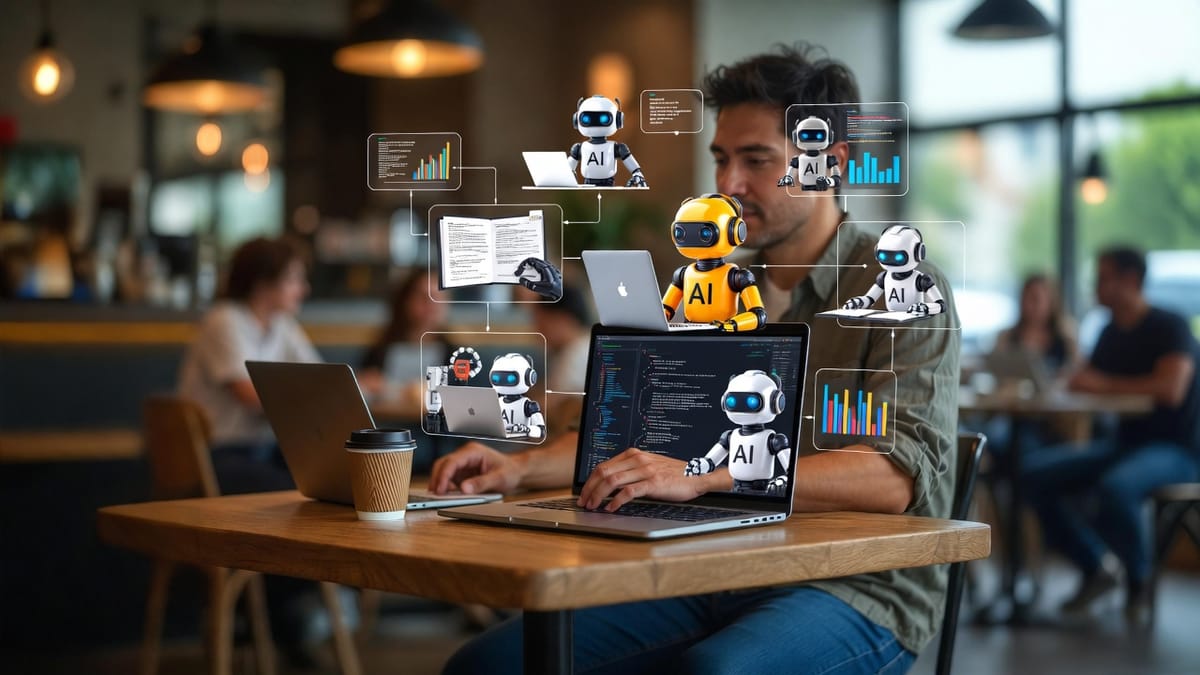
That model is being replaced by something meaningfully different: agentic AI. Instead of waiting for you to ask, AI agents take action. They read your inbox, handle tasks, browse the web, write and schedule content, manage workflows, and work inside the tools you already use, without you needing to prompt them for each individual step.
The most dominant trend in AI right now is agentic AI tied to everyday work tools. This means AI is moving beyond answering prompts and starting to take actions like reading inboxes, managing task lists, handling repetitive workflows, and helping inside apps people already use every day. The shift is from chatbot-style use to assistant-style action.
For creators and entrepreneurs, this is the shift that changes daily operations rather than just individual tasks. An AI agent that manages your content repurposing workflow, handles your subscriber onboarding sequence, monitors your analytics, and flags the things that need your attention is fundamentally different from an AI tool that writes a caption when you ask it to. One saves you minutes per task. The other saves you hours per day.
Google has been moving aggressively in this direction with its Gemini ecosystem, pushing from chat tools toward agents that can research, draft, plan, and act across work tools simultaneously. The practical implication for entrepreneurs is that workflows which currently require you to jump between five different tabs and manually move information between them are becoming automatable in ways they simply were not six months ago.
OpenAI just changed how it thinks about AI models and it matters for how you choose tools
OpenAI introduced a significant strategic shift this month that every creator and entrepreneur who uses AI tools should understand, because it will affect which tools are right for your specific work going forward.
Rather than continuing to build toward a single general-purpose AI model that does everything, OpenAI is now developing a family of specialized models designed for different types of work. Sol is designed for the most demanding, complex tasks where quality matters more than speed or cost. Terra balances performance and cost for everyday professional work. Luna focuses on speed and efficiency for high-volume, lower-complexity tasks.
This shift signals something important: choosing the right AI model for the right task is becoming as important as choosing the right software for the right job. A creator who uses the same AI tool for a quick caption as they do for a complex research project is leaving both performance and money on the table.
The practical implication for your workflow is straightforward. Start thinking about your AI use in terms of task categories. High-stakes, complex, long-form work benefits from the most capable models, even if they are slower and more expensive. Repetitive, high-volume, lower-complexity tasks benefit from faster, cheaper models that do not need the same level of capability. Matching the tool to the task is becoming a meaningful competitive advantage for creators and entrepreneurs who get it right.
AI video editing just crossed a significant threshold
For any creator who works with video, or any entrepreneur who uses video for marketing, training, or product content, July 2026 represents a meaningful turning point in what AI can actually do with visual content.
The combination of tools like GPT Image 2 and new video editing platforms means that creators can now edit a single reference image and automatically propagate those changes across an entire video. Change the lighting in one frame and the change applies consistently throughout. Adjust a color palette in a reference image and the entire video updates to match. This dramatically simplifies post-production while opening creative possibilities that previously required either a skilled editor or hours of manual work.
AI video tools are now producing professional results up to 63% faster than equivalent manual workflows, according to current benchmarks. More significantly, the tools that are winning are not the ones generating the most impressive single clips. They are the ones that maintain consistency across longer content, meaning character consistency, visual brand consistency, and style consistency across an entire video rather than just a compelling five-second demo.
For creators building a content business around video, the practical developments worth paying attention to right now are tools that maintain visual consistency across longer formats, platforms that chain together script, image, voice, video, editing, and publishing in a single workflow rather than requiring you to move between multiple disconnected tools, and AI video agents that handle multi-step production tasks autonomously, reducing editing time by up to 74% for narrative content according to current testing data.
The important caveat: long scenes, readable text within video, complex motion, and exact brand-safe realism are still areas where AI video tools break down. Test with short-form content first, six to fifteen second clips, and build from there rather than attempting to automate an entire long-form production workflow immediately.
The AI tools that are actually useful for creators and entrepreneurs right now
Given the volume of new AI tools launching every week, the most useful thing this edition can do is cut through the noise and tell you what category of tool is worth your attention right now based on what is actually working for creators and entrepreneurs in July 2026.
For everyday content work: General assistants like ChatGPT and Claude remain the most versatile starting point for drafting, analysis, research, and content creation. The gap between the top general assistants has narrowed, but their value for creators who need flexible, high-quality output across varied tasks remains unmatched.
For real-time information and social intelligence: Grok, xAI's model built directly into X, has become genuinely useful for creators in a way that distinguishes it from every other AI tool on this list. Because Grok has real-time access to everything happening on X, it can surface trending conversations, breaking stories, and live audience sentiment in a way that no other AI assistant can. For creators who publish on X or cover fast-moving topics like AI, social media, or current events, Grok is the tool to reach for when you need to know what is happening right now rather than what was happening six months ago when a model was last trained. It is also useful for identifying what your specific audience on X is talking about, which topics are gaining traction in your niche, and what angles on a story are underserved. If your content strategy involves staying ahead of conversations rather than reacting to them after everyone else already has, Grok deserves a place in your workflow.
For research and information: Tools built around citation-backed research, like Perplexity, are proving particularly valuable for creators who need to write authoritatively about fast-moving topics. Rather than generating plausible-sounding information, these tools surface and cite actual current sources, which matters enormously for creators who need to be accurate and credible.
For video content: The most practical choice depends entirely on your use case. Cinematic generation, avatar-based business video, short-form social clips, and video editing are now four distinct categories with different leading tools. Runway and Google Flow are competing for cinematic control. HeyGen and Synthesia dominate avatar and business video. Descript remains the strongest for editing existing footage. Choosing the wrong tool for your specific use case is now a more expensive mistake than it was a year ago.
For design and presentation: AI-integrated design tools have matured significantly and are now genuinely useful for creators who need to produce consistent visual content without a dedicated designer. The tools in this category that are winning in 2026 are the ones that maintain brand consistency across outputs rather than generating visually impressive but inconsistent one-off assets.
For customer and audience operations: AI support agents handling repetitive subscriber questions, customer inquiries, and onboarding workflows are now accessible to solo creators and small teams in ways they previously were not. For any creator who has a community, a paid product, or a service, delegating the repetitive operational layer to an AI agent is one of the highest-leverage moves available right now.
The development that could reshape how creators earn from their content
One announcement from this month deserves specific attention because its implications for creators could be significant over the next twelve to eighteen months.
A new initiative is underway to allow websites, APIs, datasets, and digital services to be paid instantly, including by AI agents. The goal is to create an infrastructure layer where AI agents can pay for access to content and services on behalf of their users, rather than scraping or accessing content without compensation.
If this infrastructure develops as intended, it could create an entirely new revenue stream for creators who produce content that AI agents find useful to access on behalf of their users. A newsletter, a course, a research archive, a specialized database, all of these could potentially generate micropayments each time an AI agent accesses them to answer a user's question.
This is early and the outcome is genuinely uncertain. But it is worth paying attention to because it represents the first serious attempt to resolve one of the creator economy's most significant emerging tensions: the fact that AI models and agents are trained on and continuously access creator content without compensating the people who produced it. If this model works, it changes the economics of publishing content online in ways that benefit creators directly.
The practical reality for small teams and solo creators
Across all of this month's AI developments, one thread runs consistently through everything. Small teams now have a genuine shot at competing above their weight, but the bar has risen. If a two-person team can now ship research, content, support, and product work at the speed of a ten-person team from two years ago, then the excuse that you do not have enough resources becomes significantly weaker.
The winners of today will not be the people who talk most about AI. They will be the people who turn AI into disciplined, repeatable business action.
That distinction is more important than it sounds. There is a significant gap between creators and entrepreneurs who use AI opportunistically, reaching for it when they remember it exists, and those who have built it into their workflows systematically, with specific tools handling specific categories of work on a reliable, repeatable basis. The second group is building a compounding advantage. Every week their systems run, they are getting more output for the same input. The first group is getting the same sporadic benefit they always got from an interesting tool.
The question July 2026 is asking every creator and entrepreneur is not whether AI is real or whether it is worth using. Those questions are settled. The question is whether you are using it with enough discipline, specificity, and consistency to actually change how your business operates, or whether you are still treating it like a toy you occasionally pick up when you need a caption.
Now, pick one repeated task in your workflow that currently takes more than an hour per week and costs you creative energy rather than generating it. Research which AI tool or agent is specifically built to handle that category of work. Implement it this week. Review the results in thirty days. That single disciplined action, repeated every quarter, is how the creators and entrepreneurs pulling ahead are actually using today.