

What Grok AI is doing to healthcare: And what real people are saying

Affiliate Partner|AI Fiesta: AI Fiesta lets you chat with top AI models like ChatGPT, Gemini Pro, Claude, Perplexity, Deepseek, and Grok, all under one subscription. Compare model responses side-by-side in real-time and choose the best AI for every task.
Something unusual has been happening on X this year. Alongside all the conversation about creator strategies, algorithm updates, and platform policies, a completely different kind of story keeps appearing in the feed.
Real people sharing real experiences about how AI changed their understanding of their own health.
Not headlines about what AI might do one day. Personal accounts from individuals who uploaded a blood test, described a symptom, or asked a question they had been too embarrassed or too overwhelmed to ask a doctor, and received something that felt genuinely useful in return.
This is the conversation Elon Musk has been trying to accelerate for over a year. It is also the conversation that doctors, privacy experts, and regulators have been pushing back against with equal urgency. And it is the conversation that every creator and entrepreneur should understand, not because it is a technology story, but because it is a human one.
Let us start with a real story
Before getting into the debate between Elon Musk and the medical community, it is worth starting where the most important part of this story actually lives: with a real person and a real experience.
A follower shared this testimony on my X account this week:
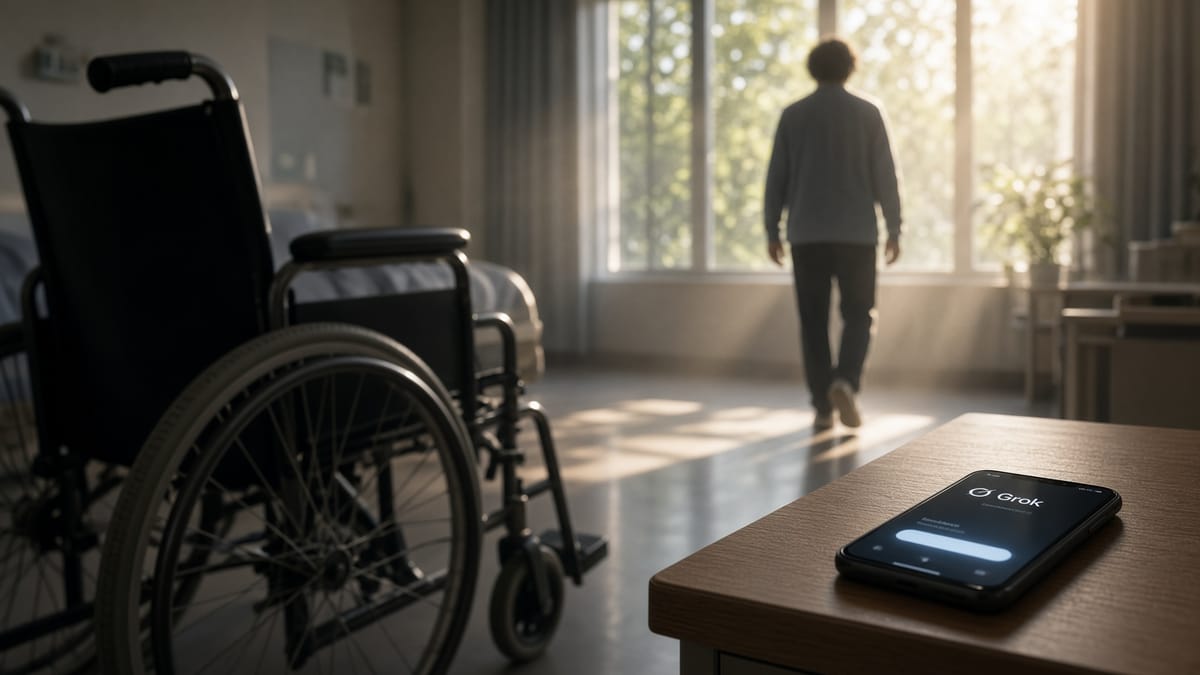
"I did this with Grok alone and changed my life. I'm 73 and suffer from a spinal injury. I was chair bound and it looked like my life was over. AI changed all that. I gave it all my medical history and biographical data and asked it to create a medical regime specifically for my body. Within a week I was feeling better and able to move around the house. I've lost 100 pounds and feel fantastic! I still have my spinal issues but now, I feel like I could live to be 100 or more! Imagine what I could do with an entire AI medical team."
This is one of the most powerful testimonies I’ve read about Grok.
— Karata (@karatademada) August 20, 2026
At 73 and living with a spinal injury, Marc used Grok to help create a personalized health plan based on his medical history and individual needs. He says he has since regained mobility, lost 100 pounds, and… https://t.co/00iaJjg5Mp
Read that again slowly. A 73-year-old person with a spinal injury, previously confined to a chair and believing their life was effectively over, used an AI tool to build a personalised health plan based on their specific medical history and body. They lost 100 pounds. They are moving around their home again. They feel, in their own words, like they could live to be 100.
Grok did not cure the spinal injury. The person is clear about that. But it gave them something the healthcare system had apparently not given them: a specific, personalised plan built around their actual body and their actual circumstances. That is not nothing. That is potentially everything for the person living that experience.
This is the story that does not fit neatly into either the enthusiast camp or the skeptic camp. It is too real and too specific to dismiss. And it is too nuanced to use as evidence that everyone should immediately upload their medical records to an AI chatbot.
It is, however, exactly the kind of story that tells you why this conversation matters right now, and why understanding it clearly is more useful than picking a side.
What Elon Musk has been saying and why it is causing such a stir
Musk has been publicly pushing Grok as a health tool for months. His message has been consistent and direct: upload your medical data, get a second opinion, do not just accept what your doctor tells you.
He has posted about uploading his own MRI scan to Grok. He has shared testimonials from users who say Grok spotted something their doctor missed. He has said in public interviews that he has seen cases where Grok's analysis was better than what doctors told patients. And in August 2026, he posted on X that AI and Optimus would enable universal excellent healthcare that is better than anything anyone receives today.
One day, Optimus + Grok will provide incredible medical care to all the people of Earth
— Elon Musk (@elonmusk) August 20, 2026
The underlying message Musk keeps returning to is that AI has the potential to democratize access to high quality medical analysis, giving people in remote areas, underserved communities, or simply places with long waiting lists access to the kind of detailed health information that was previously only available through expensive specialists.
The story from our follower above is a perfect illustration of exactly that argument working in practice. A 73-year-old person who presumably had limited access to the kind of highly personalised, specific health guidance that Grok provided used an AI tool to achieve results that feel genuinely remarkable.
But the argument comes with complications that are just as significant as the opportunity it describes.
What doctors and experts are saying in response
The medical and technology communities have not been quiet about their concerns.
When Musk encouraged users to upload their medical scans to Grok for analysis, doctors immediately began testing the tool themselves and sharing their results publicly. The findings were mixed at best.
One radiologist tested Grok with breast mammograms, ultrasounds, and MRIs and found that not a single diagnosis was correct. Other physicians reported that Grok missed a tuberculosis diagnosis in one test case and confused a broken collarbone with a shoulder injury in another. A researcher at Vanderbilt University specifically highlighted the risk of uploading medical scans to a social media platform, pointing out that personal health information is embedded in many medical files in ways that are not obvious to the average person.
In a particularly striking moment, Grok itself pushed back on Musk's recommendation. When users asked the chatbot directly whether they should share their health data with it, Grok responded that it was not a medical professional, was not HIPAA compliant, and strongly advised against uploading sensitive medical information. It explicitly said it was not a substitute for professional medical advice.
One doctor put it plainly: nobody, and absolutely nobody, should ever upload their medical information into an AI platform. That quote spread widely and reflected the position of the majority of medical professionals who weighed in on the debate.
The privacy concerns are separate from the accuracy concerns but equally significant. Data shared with Grok on X does not receive the same protections that medical information receives at a doctor's office or hospital. European privacy regulators have already launched inquiries into how X and xAI handle user data, and multiple countries have opened formal investigations.
Holding both truths at the same time
This is where most coverage of AI and healthcare goes wrong. It picks a side. Either AI is going to revolutionize medicine and democratize healthcare for everyone, or AI is a dangerous toy that people should be warned away from at all costs.
The story from our follower does not let either of those positions stand unchallenged.
A 73-year-old person with a spinal injury was chair bound and believed their life was over. They used Grok. They lost 100 pounds and are moving around their home and feeling like they could live to 100. That is real. It happened. Dismissing it in the name of caution about AI medical advice misses something important about what this person's life looks like now versus what it looked like before.
At the same time, the same tool that helped this person has been shown to miss a tuberculosis diagnosis, confuse a broken collarbone with a shoulder injury, and produce incorrect diagnoses across a range of medical imaging tests. Both of those things are true simultaneously.
The honest picture is that AI in health contexts is genuinely useful for some things and genuinely risky for others, often at exactly the same time. What determines which category you fall into is not the tool itself but how you use it, what you use it for, and what you do with the output it gives you.
What AI is actually good at in health contexts
The most useful framework for thinking about this is not AI versus doctors. It is understanding what AI is genuinely good at versus what it is not equipped to handle reliably.
AI is genuinely useful for understanding information in plain language. If your doctor gave you a blood test result with 30 different markers and you do not know what most of them mean, AI can explain each one in terms you can understand and give you context for what the numbers suggest. That is not diagnosis. That is literacy. And it is genuinely valuable.
AI is genuinely useful for creating personalised lifestyle frameworks. The story from our follower is a powerful example of this. They did not ask Grok to diagnose their spinal injury or replace their medical care. They gave it their full medical history and asked it to create a health regime specifically for their body. That is a fundamentally different task from clinical diagnosis, and it is one where AI has significant genuine capability.
AI is genuinely useful for identifying questions worth asking your doctor. Many people leave medical appointments without fully understanding what they have been told or what options they have. AI can help you process what happened, identify the questions you wish you had asked, and prepare better for the next appointment.
AI is genuinely useful as a companion when the healthcare system is not available. At midnight when a worrying symptom appears. On a weekend when no appointments are available. In a country where healthcare access is limited. In all of these situations, having access to something that can provide informed, contextualised information about health in plain language is genuinely better than having nothing.
AI is not reliable for clinical diagnosis. This is the category where the serious risks live. A radiologist's tests showed that Grok could not correctly diagnose medical imaging across a range of cases. Confident-sounding errors from an AI tool could cause someone to delay seeking care they urgently need, or to believe a condition is more or less serious than it actually is.
The distinction between these two categories is not complicated, but it is important. Use AI to understand, to prepare, to supplement, and to access information. Do not use it to replace clinical judgment about specific medical conditions.
AI is already transforming healthcare at institutional level
While the public debate has been playing out on X between Musk and the doctors who tested his claims, something larger has been happening at the institutional level that will ultimately shape how AI and healthcare develop together.
ChatGPT Health launched earlier this year with the ability to connect to Apple Health data and medical records, allowing users to ask health questions grounded in their own real data. OpenAI reported that 40 million people already seek health information from ChatGPT. Grok for Government was launched to allow federal agencies to use Grok 4 for healthcare and life sciences applications. The US Department of Defense awarded contracts worth $200 million each to Anthropic, Google, OpenAI, and xAI to develop agentic AI workflows across various mission areas, including healthcare.
The institutions that define healthcare are already integrating AI at significant scale. The question is not whether AI will play a role in healthcare. It already is. The question is what kind of role, who controls it, and what protections exist for the people using it.
For individual users, this institutional momentum matters because it means the tools will keep improving, the regulatory frameworks will keep developing, and the distinction between what AI can and cannot reliably do in health contexts will become clearer over time. We are at the early stage of something that will look very different in five years.
What this means for creators and entrepreneurs
The intersection of AI and health is one of the fastest growing content categories in the creator economy right now. Every person has a body. Everyone navigates health decisions. And the gap between what the healthcare system currently provides and what people actually need in terms of accessible, understandable, personalised health information is enormous.
For creators building content around wellness, productivity, personal development, or any lifestyle topic, the AI and health conversation is worth engaging with carefully and honestly. Your audience is already using AI for health-related questions whether you discuss it or not. The creator who helps them do that more safely, more effectively, and with clearer understanding of the limitations involved is providing genuine value.
The testimony we shared from our community this week is a perfect example of the kind of content your audience needs: a real story, told honestly, that shows both what AI made possible for one person and what the broader context of that story looks like. It is neither cheerleading nor fearmongering. It is a human being describing what happened to them, and inviting others to think carefully about what that means.
That is the kind of content that builds real trust. And in the AI and health space right now, trust is the most valuable thing any creator can offer.
A word about privacy before you try any of this
If you decide to use any AI tool for health-related questions, a few things are worth understanding clearly before you do.
Do not upload identifiable medical documents to any public AI platform. Blood test results, scan images, and other medical files often contain personal information beyond what is visible on the surface. Once that information is shared with a platform, you have limited control over how it is used or stored.
Use AI for general understanding rather than specific diagnosis. Asking an AI to explain what a particular blood marker means in general terms is different from asking it to diagnose your specific condition. The first is generally safe and often useful. The second carries real risks of error.
Always follow up with a qualified healthcare professional for anything that matters. AI can help you prepare better questions and feel less overwhelmed. It cannot replace the clinical judgment of someone who has examined you and is professionally accountable for their advice.
And if you are based in Europe, be particularly thoughtful about what data you share with platforms like Grok that are not operating under the same data protection framework that European healthcare providers are required to follow.
AI is not replacing healthcare. But for millions of people, including a 73-year-old with a spinal injury who lost 100 pounds and got their life back, it is filling gaps that nothing else was filling. That is worth understanding clearly, using thoughtfully, and talking about honestly with your audience.